
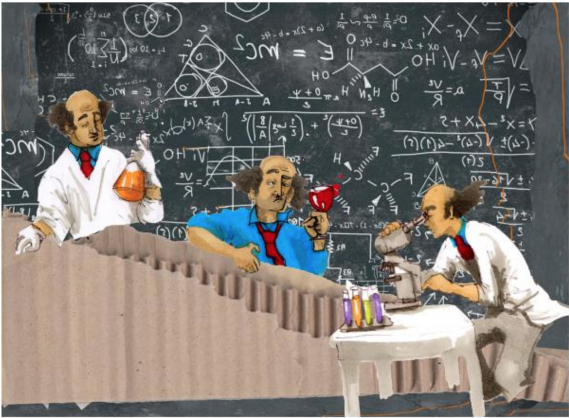
There is a question, inevitably raised during family gatherings, which provokes fear and anxiety in the mind of students: “So, what are you going to do after you graduate?” Thankfully, I have an answer all prepared. “Research,” I say confidently. Only, I recently realized my perception of what life as a researcher entails only came from what I had seen on TV, and that actually, I hand’t a clue what the word meant.
For most of us, popular culture – television in particular – provides an insight into environments we would otherwise know nothing about. Crime shows and legal dramas, for example, give us an idea of what the life of a detective or a lawyer might be like, but based on typical portrayals of scientists on screen, you would expect every lab to be filled with socially-challenged, eccentric, workaholic white males.
The common factor in the stereotypes of scientists in popular culture is their depiction as outsiders. In a recent publication aiming to break down such stereotypes, Antonio Tintori of the the Sapienza University of Rome explains that this is linked to the co-evolution of the image of scientists with the words ‘geek’ and ‘nerd’. It is rare to find a scientist on television who isn’t completely defined by their work and their understanding of technical jargon, whose function in the story isn’t related to their scientific pursuits. People usually imagine scientists in white lab coats, set apart in dress as well as in mind. This reinforces a common perception that scientists are out of touch with reality, prodigies who are isolated because of their social awkwardness, and make up for it by throwing themselves unreservedly into their work. A prime example of this is Temperance Brennan, the hyper-rational forensic anthropologist in the television series Bones, whose commitments to facts and evidence over feeling leaves her distant and socially clueless.
What about The Big Bang Theory? Here is a show where accurate scientific content meets pop culture, showing scientists in their life outside the lab. Though the show does negate some stereotypes, it also reinforces others, for instance specifically associating scientific aspirations with geek culture. The show’s scientists are vulnerable, awkward and socially challenged geniuses, isolated by their knowledge and geekiness. Kaley Cuoco’s character Penny, a ‘Wendy to the Lost Boys’, is what makes the scientists approachable to the audience; repeatedly using the knowledge gap between Penny and the scientists for comic relief.
So, in spite of all the scientists I had seen on television, I didn’t have an accurate idea of what a typical day of research looked like. I imagined there to be a flurry of activity, scientists jumping from one experiment to the next with a swish of a lab coat, fuelled by a succession of eureka moments. I imagined long days with few breaks, incompatible with family life. I was worried that I would never fit in, that my knowledge of science wasn’t encyclopedic enough, that I wasn’t enough of a nerd. Then, as part of my year abroad in Sweden, one of the courses offered was a 10 week internship in the research lab of my choice. I decided to take the plunge.
What I found was far from what I had imagined. The lab is quiet and relaxed. At any given moment, few researchers are conducting experiments. The ones that are have earphones in, phone tucked into the back pocket of their jeans, lab coat hanging on a hook in the corner. The office always contains food that people have either baked or brought in for meetings and coffee breaks. People are friendly and eager to share their insights or discuss experimental issues, because they will readily admit that their scientific knowledge isn’t exhaustive. More importantly, the people who make up the lab are incredibly diverse, and it surprises no-one to hear Spanish, Mandarin or Hindi spoken rather than English or Swedish. Half of the researchers are women, most are young. I found people who are passionate and dedicated, but also open and funny, each with a unique set of interests. The one thing they all share, however, is the capacity to look down a microscope at a developing embryo or a stained tissue and say “Wow”. Or alternatively, “Huh, that’s weird”.
In that sense, at least, we are most definitely nerds.
Published in the Spring 2018 edition of EUSci, the University of Edinburgh science magazine.
 Sciential